Brand DNA vs. Brand Identity: Differences, Examples, and How to Build Both
Learn the difference between brand DNA and brand identity, with examples, a comparison table, a practical worksheet, and answers to common branding questions.
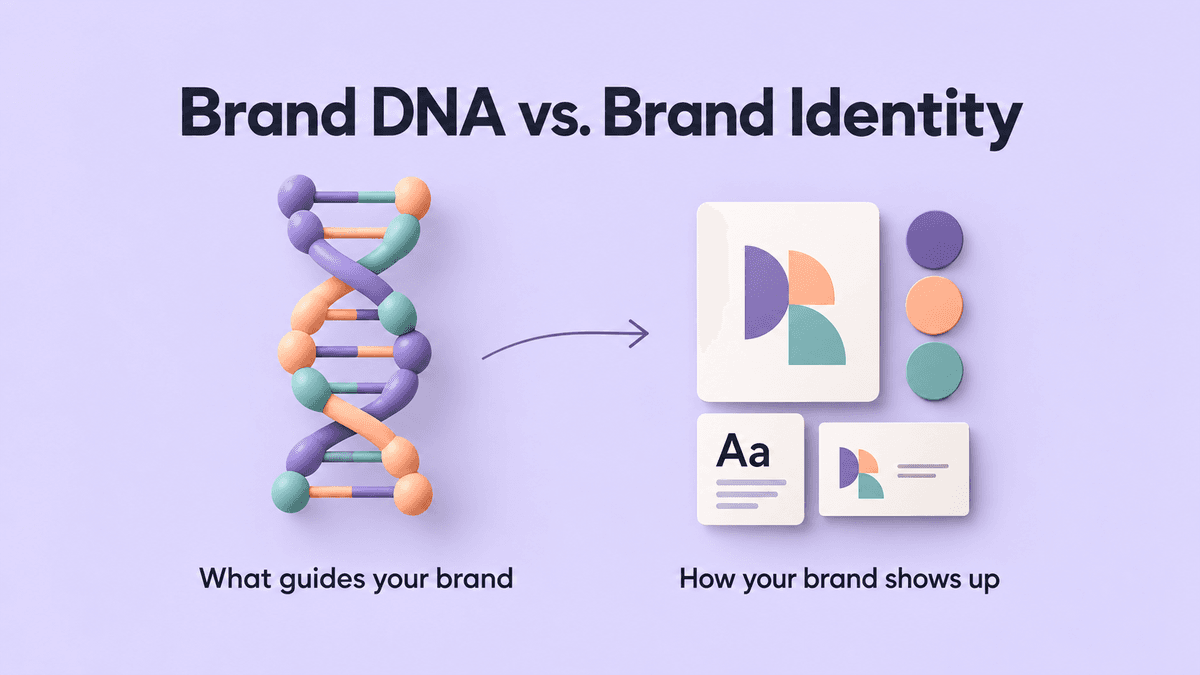
Brand DNA is the set of enduring beliefs, promises, and distinguishing traits that guide a brand. Brand identity is the system a business develops to express who it is, including its name, logo, colors, typography, voice, and recognizable experiences. Your DNA guides decisions; your identity makes those decisions visible and understandable.
If you are starting a business or refreshing your branding, understanding brand DNA vs. brand identity helps you answer two different questions: What should this business stand for? And how should people recognize it?
This guide explains where the concepts overlap, how they differ from brand image and positioning, and how to turn a short strategic brief into a practical identity with LogoAI.
Brand DNA vs. brand identity: the key differences
There is no universally agreed boundary between these terms. Some branding frameworks include purpose and values within brand identity; others use identity mainly for visual and verbal expression. Here, we use brand DNA for the strategic core and brand identity for the system that expresses it.
| Question | Brand DNA | Brand identity |
|---|---|---|
| What does it describe? | The beliefs, promise, and characteristics guiding the brand | The coordinated signals used to present the brand |
| What does it include? | Purpose, values, personality, differentiation, and customer promise | Name, logo, colors, type, imagery, voice, and usage rules |
| What does it help decide? | Which opportunities and behaviors fit the business | How communications and assets should look and sound |
| How is it documented? | A concise strategy brief or brand DNA statement | Brand guidelines and an organized brand kit |
| How often does it change? | Usually more slowly, as business direction evolves | Can adapt as channels, products, and practical needs change |
| How do you assess it? | Does it reflect a meaningful, deliverable promise? | Does it communicate that promise clearly and consistently? |
Neither replaces the other. A thoughtful strategy can remain invisible without a recognizable identity. Attractive design can create the wrong expectations when it lacks strategic direction.
What is brand DNA?
Brand DNA is a useful metaphor for the qualities that make a business recognizably itself. It describes what you intend to preserve across products, communications, and customer interactions, even as individual designs change.
Brand strategist Peter Wilken’s explanation of brand DNA connects the concept to a brand’s role, promise, benefits, culture, and identifying attributes. His framework also shows why DNA is broader than a purely visual brief: it influences what a company does as well as what it says.
For a small business, a practical DNA statement should clarify:
- Purpose: The customer problem you exist to address.
- Values: Principles that influence real choices and tradeoffs.
- Promise: The experience customers should be able to expect.
- Personality: The human traits that shape your communication.
- Difference: A relevant reason to choose you over alternatives.
- Proof: Behaviors, capabilities, or evidence supporting your claims.
“Quality, innovation, and trust” is rarely enough. Those words become useful when you explain what they require. A repair company might express trust through written estimates, clear arrival windows, and explanations before additional work begins.
What is brand identity?
Brand identity gives your intended meaning a repeatable form. It helps someone recognize your website, packaging, social posts, invoices, and customer messages as coming from the same business.
Names, logos, colors, and typography help connect a business’s purpose to its outward presentation. A logo is an important identity asset, but it cannot carry the entire brand alone.
A useful identity system usually includes a primary logo, supporting logo formats, a color palette, typography, image direction, and voice guidelines. It also explains how these elements work together. A folder of individually attractive graphics does not automatically form a coherent system.
For example, a calm, supportive service might use clear layouts and reassuring language. That is a design hypothesis to test with customers, not a universal rule that a particular color always communicates a particular emotion.
Brand DNA, brand identity, brand image, and positioning
These related concepts answer different questions:
Brand DNA: What principles and characteristics guide us?
Brand positioning: Why should a particular audience choose us instead of the available alternatives?
Brand identity: How do we intentionally present ourselves?
Brand image: What do people actually believe and associate with us?
You can define your intended identity, but you cannot dictate the resulting image. Customers form impressions through your product, prices, service, reviews, and communications.
Suppose a software company wants to be known for simplicity. Its DNA prioritizes removing unnecessary work. Its positioning targets owners who find existing tools too complicated. Its identity uses direct language and uncluttered layouts. If onboarding still takes hours, customers may perceive complexity despite the branding.
The mismatch is an experience problem, not simply a logo problem.
A practical example: one business, two layers
Consider a fictional neighborhood bakery called Hearth & Grain.
Its brand DNA could be: “Make everyday bread feel worth slowing down for, through careful baking, straightforward ingredients, and welcoming service.” Its personality is warm and knowledgeable. Its promise is dependable everyday enjoyment rather than exclusive luxury.
That direction could produce an identity with an approachable wordmark, clear product labels, photographs showing the bread and baking process, and friendly explanations of ingredients. The packaging should be readable and practical, not so ornate that it makes a daily purchase feel intimidating.
The same DNA could support several visual styles. A restrained modern identity or a hand-drawn neighborhood style might both work. Strategy narrows the options; it does not dictate one inevitable font.
For a real example of purpose influencing business decisions, Patagonia’s ownership explanation describes a structure intended to support environmental protection. The useful lesson is that a stated purpose can affect governance and resource allocation, beyond advertising or visual design. You do not need a comparable ownership structure, but your values should have observable consequences.
Which comes first: brand DNA or brand identity?
Start with enough strategic clarity to make design decisions, then develop and test the identity. You do not need a lengthy strategy project before trying a logo.
For an early business, a one-page brief is usually a practical starting point. Describe the audience, their problem, your promise, your difference, and three personality traits. Explore designs against that brief, then improve both as you learn.
An established business should also review existing recognition. Customers may already connect a particular symbol, color combination, or phrase with you. Replacing everything because a new style feels fashionable can discard something useful.
The process is iterative: strategy informs design, customer responses reveal misunderstandings, and those findings improve the next decision.
How to define your brand DNA in five steps
1. Identify a specific audience and problem
Replace “our product is for everyone” with a useful starting audience. Who experiences the problem most strongly? What are they using now? What frustrates them about it?
Use customer conversations, support requests, and reviews to check your assumptions. Founder preference alone is not evidence of customer demand.
2. Write a promise you can deliver
Describe the benefit in everyday language. “Help first-time business owners create a coordinated brand without managing several separate design projects” is more actionable than “empower creativity.”
Check whether your product and service actually support that promise today. Separate your current commitment from your future ambition.
3. Turn values into behavior
For every value, write one action and one tradeoff. If accessibility matters, what will you simplify or test? If transparency matters, what information will you show before purchase?
This prevents the DNA document from becoming a list of appealing but interchangeable adjectives.
4. Define personality with boundaries
Choose a few traits and explain their limits: friendly without being flippant, expert without being condescending, energetic without being chaotic.
Those boundaries help a designer or writer make decisions when several creative options seem plausible.
5. Document your difference and proof
Explain what makes your approach meaningfully different for your audience. Then identify supporting evidence: a process, specialization, product capability, or service commitment.
Avoid calling yourself “the best” when you cannot substantiate the comparison. A specific, believable distinction gives your identity more useful direction.
How to turn brand DNA into a visual identity with LogoAI
Start with a clear brand brief
LogoAI’s AI logo generator describes its approach as interpreting a business’s name, industry, and intent to identify brand traits and explore suitable styles. This can help you move from an abstract idea to visual directions you can compare.
Treat the AI’s interpretation as a starting proposal. It cannot establish your company’s real values, customer relationships, or competitive advantage from a name alone. Use your brief to evaluate whether the suggested direction fits.
Evaluate concepts against the same criteria
Ask whether each logo matches your intended personality, reads clearly, feels sufficiently distinct, and works in the places customers will see it.
A striking illustration may suit a large sign but become confusing as a small profile image. A delicate signature may fit a personal brand but lose clarity on some applications. Evaluate actual use rather than choosing only the most impressive preview.
Build a coordinated brand kit
Once you have a direction, LogoAI Brand Kit helps extend a logo into a broader collection of identity assets. Use it to develop coordinated applications, then review the outputs for consistency with your brief.
Keep approved versions together and document practical rules: which logo belongs on dark backgrounds, which colors are primary, and how headings and body text should work together. Check readability and contrast rather than assuming a generated palette is suitable for every use.
Maintain the strategy as you create more assets
As the business grows, compare new materials with the same promise and personality boundaries. A new campaign can feel fresh without introducing an unrelated voice or visual style.
If you are choosing a starting tool, our LogoAI, Looka, and Tailor Brands comparison explains different approaches to logo and brand creation. Choose a workflow that helps you evaluate fit, not just generate more options.
A simple brand DNA worksheet
Complete these sentences before your next design session:
- We help [specific audience] solve [specific problem].
- Customers choose us because [meaningful difference].
- They can expect [clear, deliverable promise].
- We behave like [three personality traits].
- Our values show up when we [observable actions].
- Our identity should communicate [desired impression].
- We will avoid [misleading claims or unsuitable styles].
Give this brief to anyone creating brand materials. Ask them to explain how their choices support it. If nobody can connect the output to the brief, either the design or the brief needs another pass.
Common questions about brand DNA and brand identity
Is brand DNA the same as brand purpose?
No. Purpose describes why the brand exists or what it seeks to contribute. Brand DNA is broader, typically including values, personality, promise, and distinguishing traits. Purpose is one part of that strategic core.
Is brand identity just a logo?
No. A logo is one recognition device within the identity. Typography, colors, imagery, language, and consistent applications also contribute. A good logo cannot compensate for contradictory messaging or an unreliable customer experience.
Can a small business have brand DNA?
Yes. A solo consultant or local shop can document its audience, promise, values, and personality on one page. The benefit is clearer decisions, not a large document or an expensive workshop.
Can brand DNA change over time?
Yes. The metaphor does not mean your business is biologically fixed. New audiences, products, or ownership can justify strategic change. Distinguish a genuine change in direction from a temporary campaign or visual refresh.
Does a rebrand mean changing your brand DNA?
Not necessarily. You may update an outdated logo or improve readability while preserving the same promise. A deeper repositioning may require changes to both strategy and expression. Identify the business problem before deciding the scope.
Can AI create brand DNA for my business?
AI can organize information, suggest traits, and develop creative directions. You should validate those proposals against customer evidence and actual business behavior. An attractive generated story is not proof that the business delivers it.
How do I know whether my identity matches my DNA?
Show representative materials to potential customers without explaining the intended impression first. Ask what the business seems to offer, who it seems to serve, and what they expect from it. Compare recurring answers with your brief, then investigate the gaps.
Build the meaning before expanding the assets
Brand DNA and brand identity work best together: define a credible promise, express it clearly, and deliver it consistently. Start with your one-page brief, explore a logo direction, and build a coordinated identity around the decisions that fit. As customers respond, refine the system without losing sight of what the business actually stands for.
Ready to create your own logo?
Turn your brand name into professional logo concepts in seconds with LogoAI.
Generate my logo