Is a Signature Logo Right for Your Brand?
Find out when a signature logo suits your brand, how to test readability, and how LogoAI’s signature and image-to-logo tools can express your personal identity.
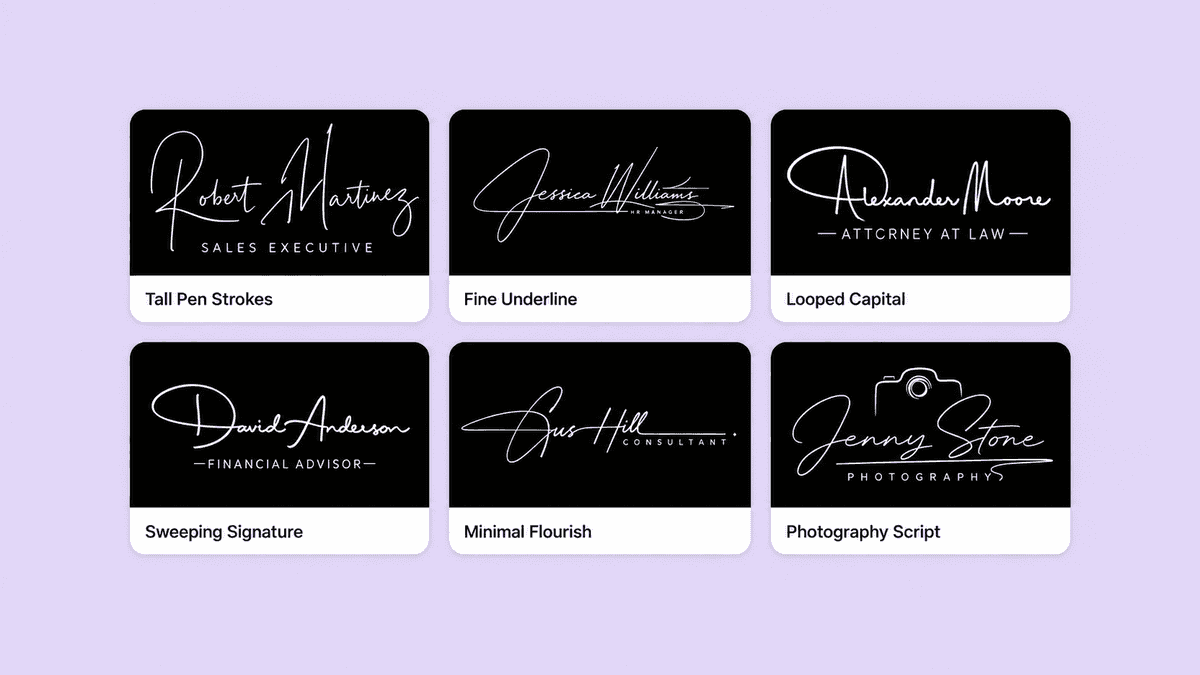
A signature logo can make a business feel personal before anyone reads its story. Flowing letters suggest a human hand behind the work, whether the name belongs to a photographer, a designer, or a small studio.
But handwritten lettering is not automatically the right choice for every brand. A beautiful signature can become difficult to read on a phone screen, and an expressive flourish may communicate the wrong personality for the business.
The useful question is whether this style helps people recognize you and understand what your brand stands for. Here is how to decide, plus how to explore your options with LogoAI’s new signature logo maker.
What is a signature logo?
A signature logo is a wordmark or letter-based identity designed to resemble handwriting. It might use a full name, a business name, or initials, with details such as connected letters, varied strokes, or an underline.
It does not have to reproduce your everyday signature. A branding version can simplify the lettering, open up cramped spaces, and make the name easier to read. Think of it as a designed expression of your identity.
Some signature logos feel delicate and elegant. Others use bold brush strokes or compact initials to communicate confidence. The style is broader than decorative cursive, so you can explore different moods without abandoning the personal quality.
When a signature logo makes sense
Your name is central to the business
If customers choose you for your taste, expertise, or creative work, a signature can reinforce that relationship. Photographers, artists, consultants, and independent designers can use a name-led identity to put the person behind the service at the center.
Imagine a photographer whose portfolio already has a distinctive visual style. A readable signature could act as a quiet finishing touch on the website, business cards, and presentation materials.
Personal attention is part of the experience
A signature style can suggest care and individual involvement. That may suit a boutique studio, handmade product business, or service where customers work directly with the founder.
The effect depends on the complete identity. Airy lettering, generous spacing, and restrained colors suggest something different from an energetic brush script. Choose the version that reflects how you want customers to experience the business.
Your main placements give the lettering room
Signature logos often work well where the name has enough space: a website header, packaging label, printed card, or presentation cover. A horizontal signature may look particularly natural in a wide layout.
If those are your main uses, the format can be practical as well as expressive. You will still need a simpler version for compact placements.
When another logo style may work better
People need to read the name instantly. Long names, tight loops, and elaborate capitals can slow recognition. If viewers mostly encounter your brand on small screens or distant signs, straightforward lettering may be a stronger starting point.
Your brand needs a compact symbol. A detailed signature rarely makes an effective favicon. You might pair it with a monogram or standalone mark, rather than force the full name into every space.
The business is deliberately separate from its founder. A personal name can remain a strong company identity, but consider whether it matches your plans. A team-led platform or broad product range may benefit from a less individual visual direction.
Thin lines struggle in your applications. Fine strokes can disappear when reduced or reproduced on textured materials. Test the design on the actual surfaces you expect to use, especially embroidery, stamps, and small labels.
A quick test before you commit
Compare each candidate in realistic conditions. Show the name to someone unfamiliar with your business and ask what it says. Reduce it to the size it will occupy on a mobile page. View it in one color and on both light and dark backgrounds.
Then ask whether the personality fits. Does the design feel approachable, artistic, understated, or assertive in the way you intended? A fashionable script is not useful if it sends the wrong message.
Keep both recognition and practicality in the decision. The strongest candidate should still work after the decorative presentation is removed.
Create options with LogoAI’s new Signature Logo Maker
Our new AI Signature Logo Maker starts with visual references, making it easier to choose a direction without describing lettering from scratch.
Browse styles such as delicate cursive, brush lettering, refined handwriting, and monograms. Select an example for its flow and composition, then enter your own name or business name. AI uses the reference to generate lettering for your text.
The tool creates four variations to compare, ranging from interpretations close to the reference to more exploratory directions. Open a result to refine or download it, or try another reference.
Start by comparing contrasting styles: one restrained, one expressive, and one compact. Check spelling and letter shapes carefully in every generated result. Your favorite reference may not be the best fit for the length or letter combinations of your actual name.
Image-to-logo offers another route to personal identity
Handwriting is only one way to make a brand feel like yours. A meaningful image can communicate a personal story through a symbol instead.
With LogoAI Image to Logo, you can upload a photo, sketch, or picture, choose a style, and optionally add a brand name. Available directions include line art, cartoon, negative space, vintage, badge, and abstract treatments.
For example, a tennis coach could start with a photo of themselves playing. A baker could use a portrait or a drawing connected to their work. The goal is a recognizable visual idea inspired by the source, rather than a photograph squeezed into a logo.
Choose a signature when the name and lettering should lead. Choose image-to-logo when a subject, activity, or personal symbol tells the story more clearly. Compare both if you are unsure: personal identity can come from your handwriting style, your image, or the way you combine a name with a meaningful mark.
Ready to create your own logo?
Turn your brand name into professional logo concepts in seconds with LogoAI.
Generate my logo