What Does Brand DNA Look Like? 8 Real Brand Examples for 2026
Explore 8 real Brand DNA examples from Nike, Apple, Duolingo, IKEA and more. See how purpose, voice and visual cues work together—and what you can learn for your own brand.
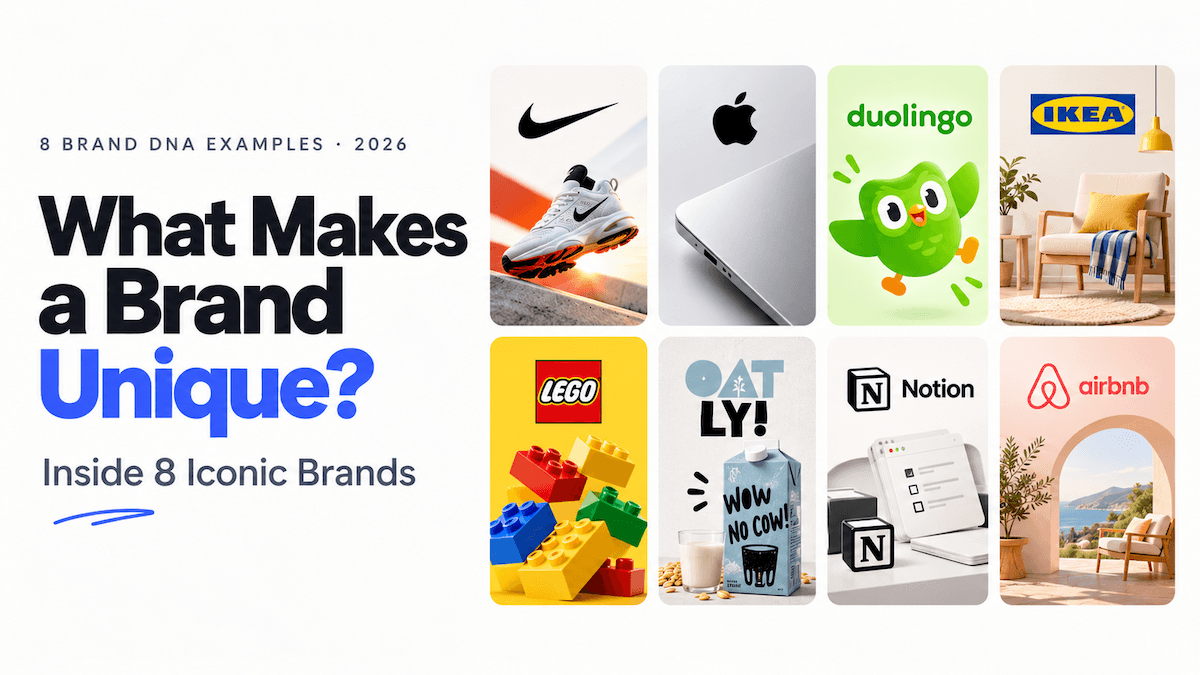
A Nike campaign can feel like a challenge to take the next step. IKEA, by contrast, makes good design feel practical and within reach. Those different impressions come from more than a logo or color palette: they reflect different choices about purpose, audience, personality, voice and visual expression.
Brand DNA is not one universal scorecard, and the brands below do not all publish a document called “Brand DNA.” These snapshots are editorial readings of public mission and values statements, products, campaigns and design cues. Where a company states a mission or value directly, it is linked; descriptions of personality and voice are interpretation. For a deeper explanation of the distinction, read our guide to Brand DNA vs. brand identity.
8 Brand DNA Examples From Famous Brands
1. Nike: Motivation built around action
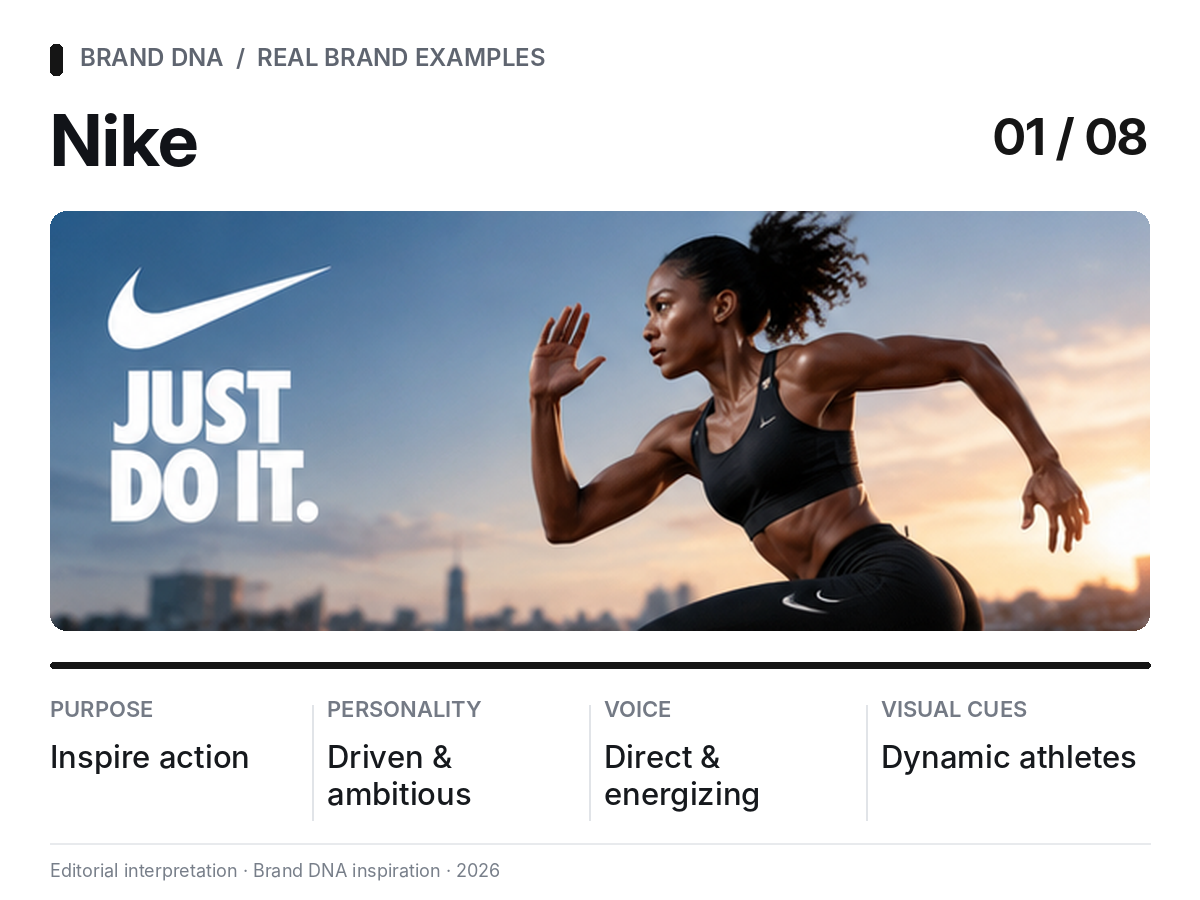
Brand DNA snapshot: Purpose: inspire action through sport. Personality and voice: ambitious, energetic and direct. Signature line: “Just Do It.”
What makes it unique: Nike’s language turns ambition into a call to move. Its 2025 “Why Do It?” campaign reintroduced “Just Do It” to a new generation and framed greatness as a choice rather than a guaranteed outcome—a clear example of purpose expressed through an invitation to act. Read Nike’s campaign announcement.
What you can learn: A mission becomes memorable when it gives people a clear next step. Choose language that invites your audience to do something, not just admire your brand.
2. Apple: Simplicity as a product decision
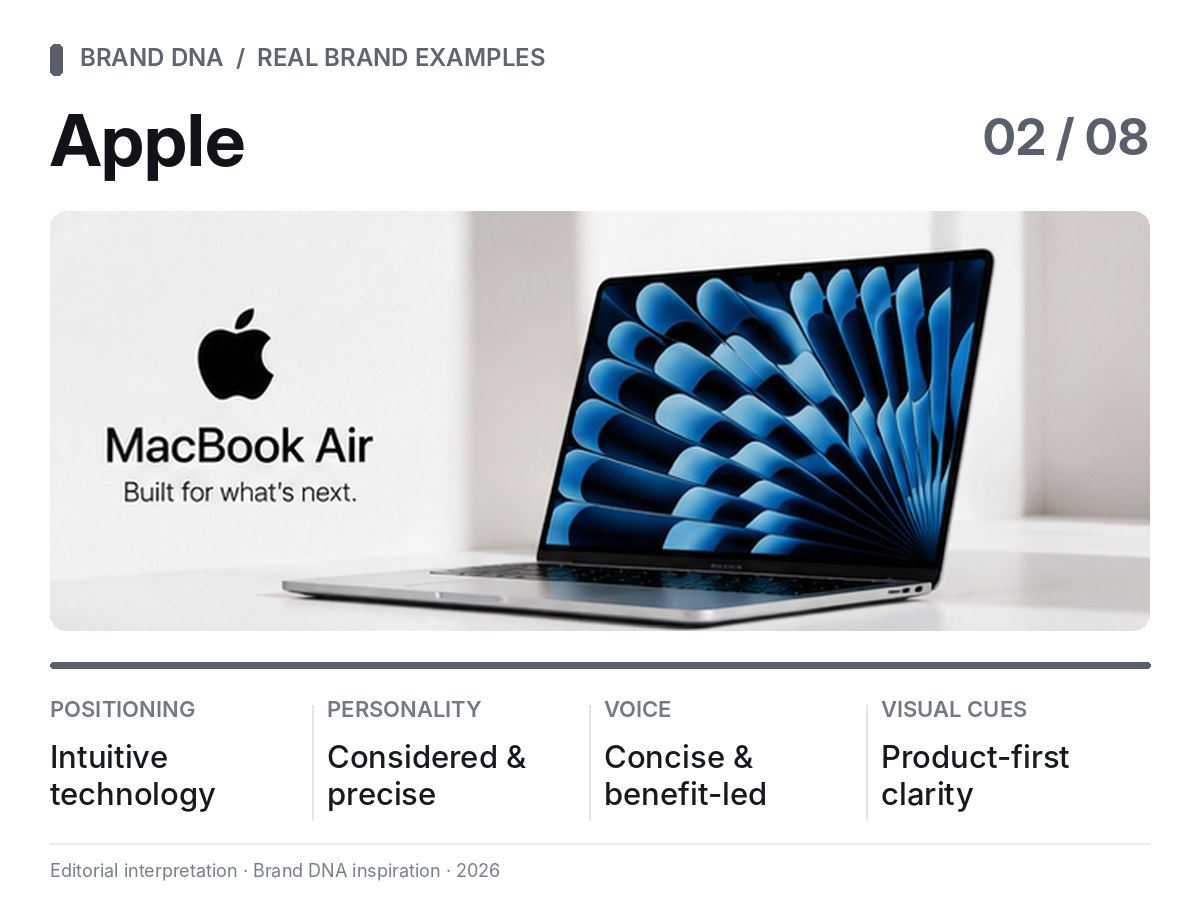
Brand DNA snapshot: Personality: considered and precise. Voice: concise and benefit-led. Visual cues: focused layouts and product-first presentation. These are observations, not an official Apple mission statement.
What makes it unique: Apple’s design guidance calls for clarity, focus and simplicity, while explicitly noting that simplicity is not the same as minimalism. That distinction matters: the goal is not to remove detail for its own sake, but to make important actions easier to understand. The company’s Human Interface Guidelines connect simplicity with craft, purpose and delight.
What you can learn: Treat simplicity as a decision rule. When an element does not help customers understand or use your product, reconsider whether it belongs.
3. Duolingo: Learning with warmth and a little sass
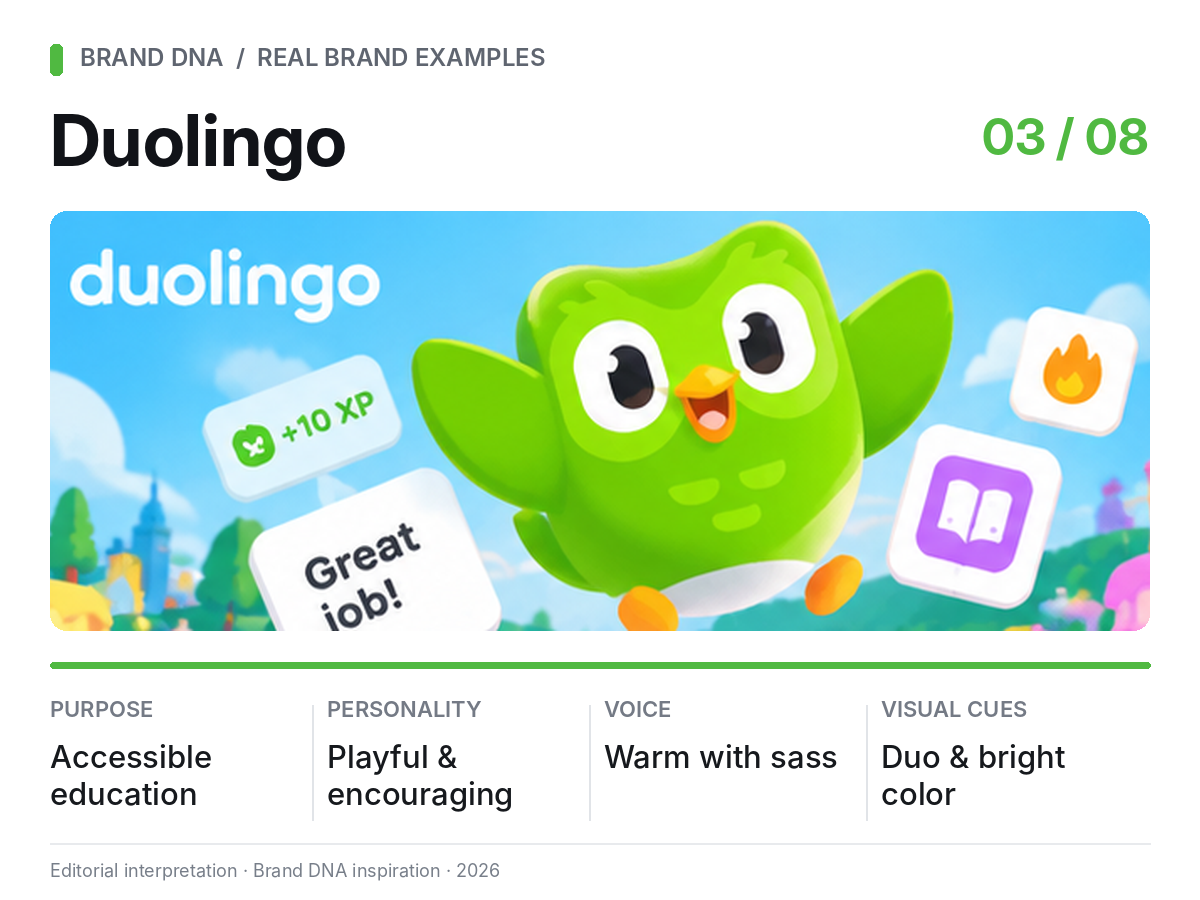
Brand DNA snapshot: Purpose: make high-quality education universally available. Personality and voice: cheerful, playful and encouraging. Signature cue: Duo the owl and a cast of characters.
What makes it unique: Duolingo says its courses are designed to entertain and delight, using warm, colorful experiences and a little sass to keep learning approachable. That playfulness supports the learning experience; Duo is not just a mascot pasted onto an unrelated product. Its teaching-method overview explains the approach.
What you can learn: Personality works best when it supports the experience. A playful voice can make a difficult task feel less intimidating when the product itself follows through.
4. IKEA: Designed for “the many people”
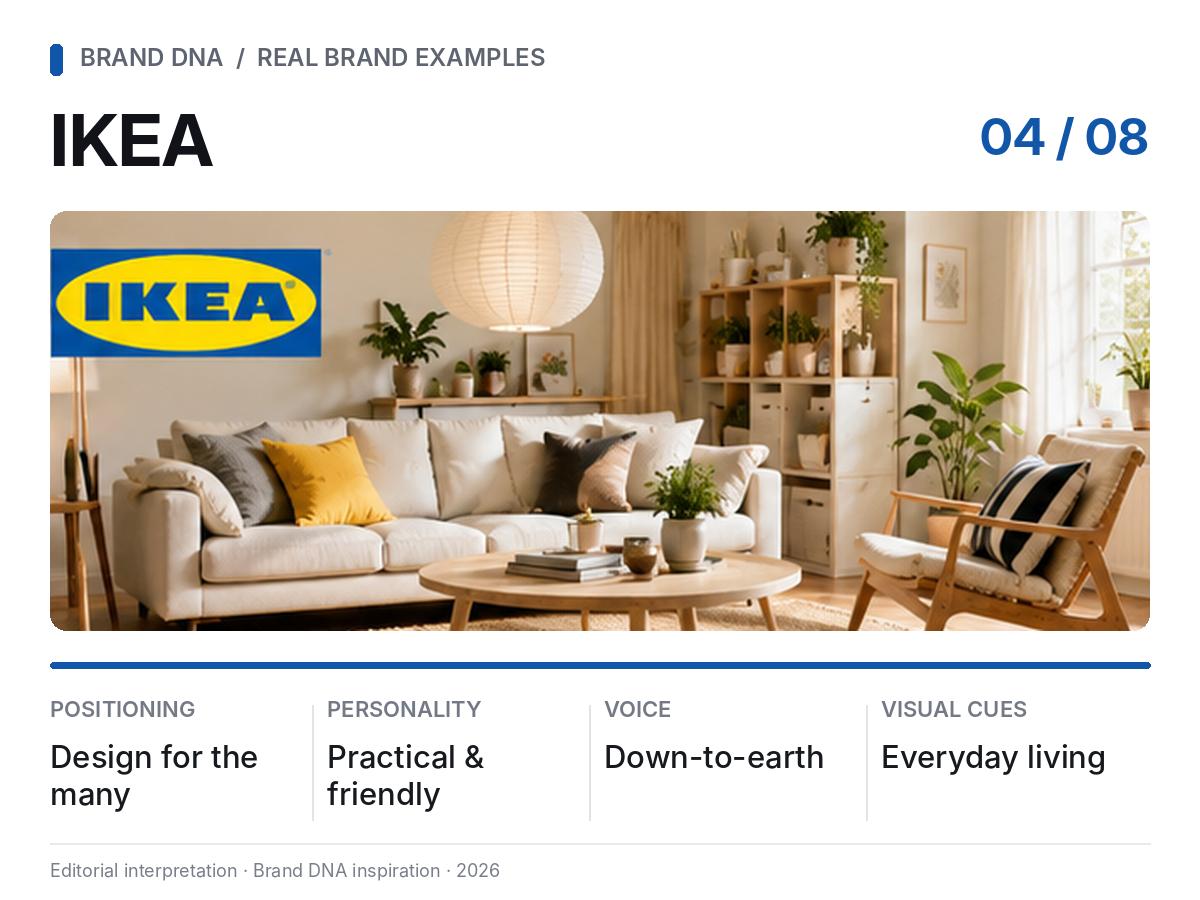
Brand DNA snapshot: Promise: good home furnishings for everyone. Positioning: design that balances form, function, quality, sustainability and low price. Personality: practical and down-to-earth.
What makes it unique: IKEA makes affordability part of the design brief alongside form, function, quality and sustainability. Its Democratic Design approach explains how these dimensions shape its products.
What you can learn: “Who is this for?” should shape more than your marketing. Let your audience influence the product, price and everyday experience too.
5. LEGO: Creativity with a shared starting point
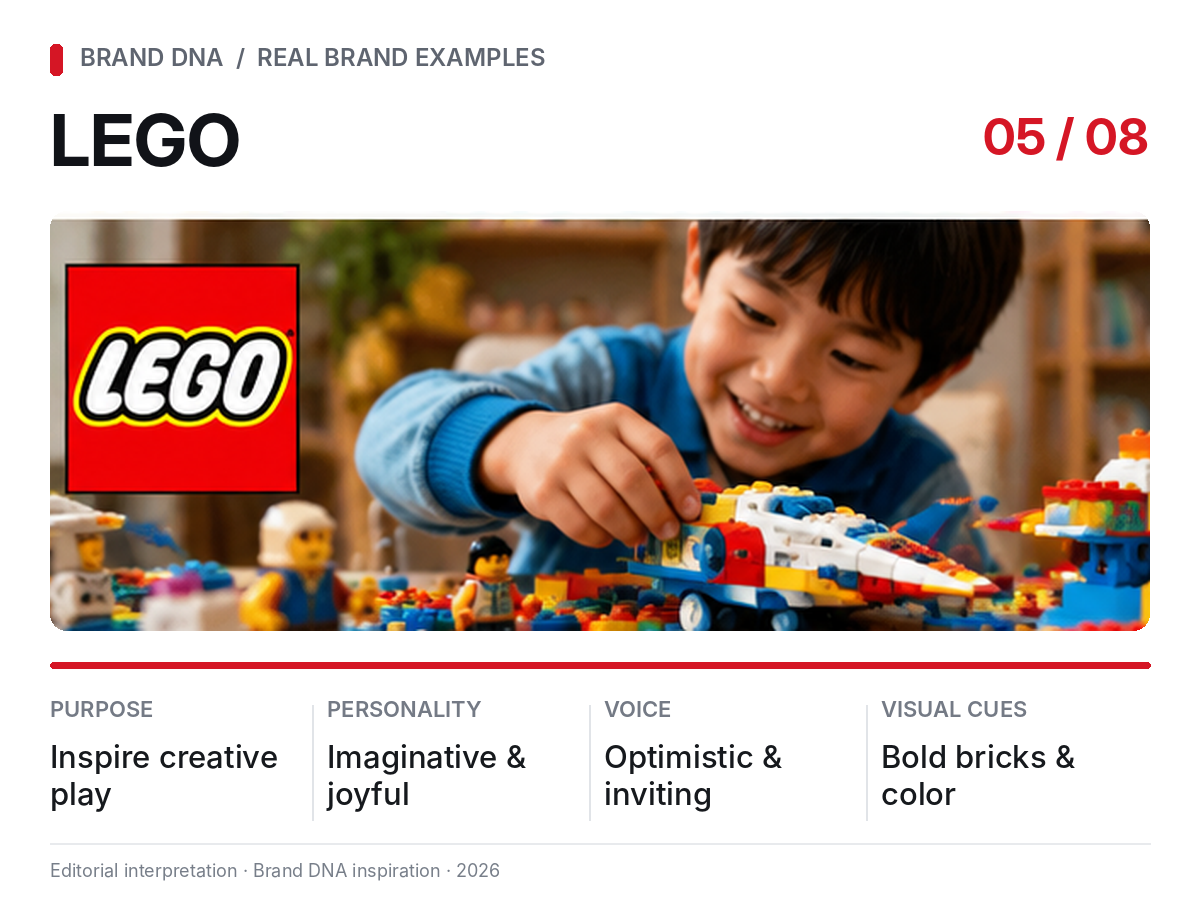
Brand DNA snapshot: Mission: inspire and develop the builders of tomorrow through play. Values: imagination, creativity, fun, learning, caring and quality. Signature spirit: “Only the best is good enough.”
What makes it unique: LEGO gives people a recognizable system of bricks, then leaves room for them to build different things. The company’s brand framework and values connect play with imagination and learning, while quality keeps the experience consistent across sets and generations.
What you can learn: A clear brand does not have to prescribe every outcome. Give customers a familiar foundation and enough freedom to make it their own.
6. Oatly: A point of view you can hear
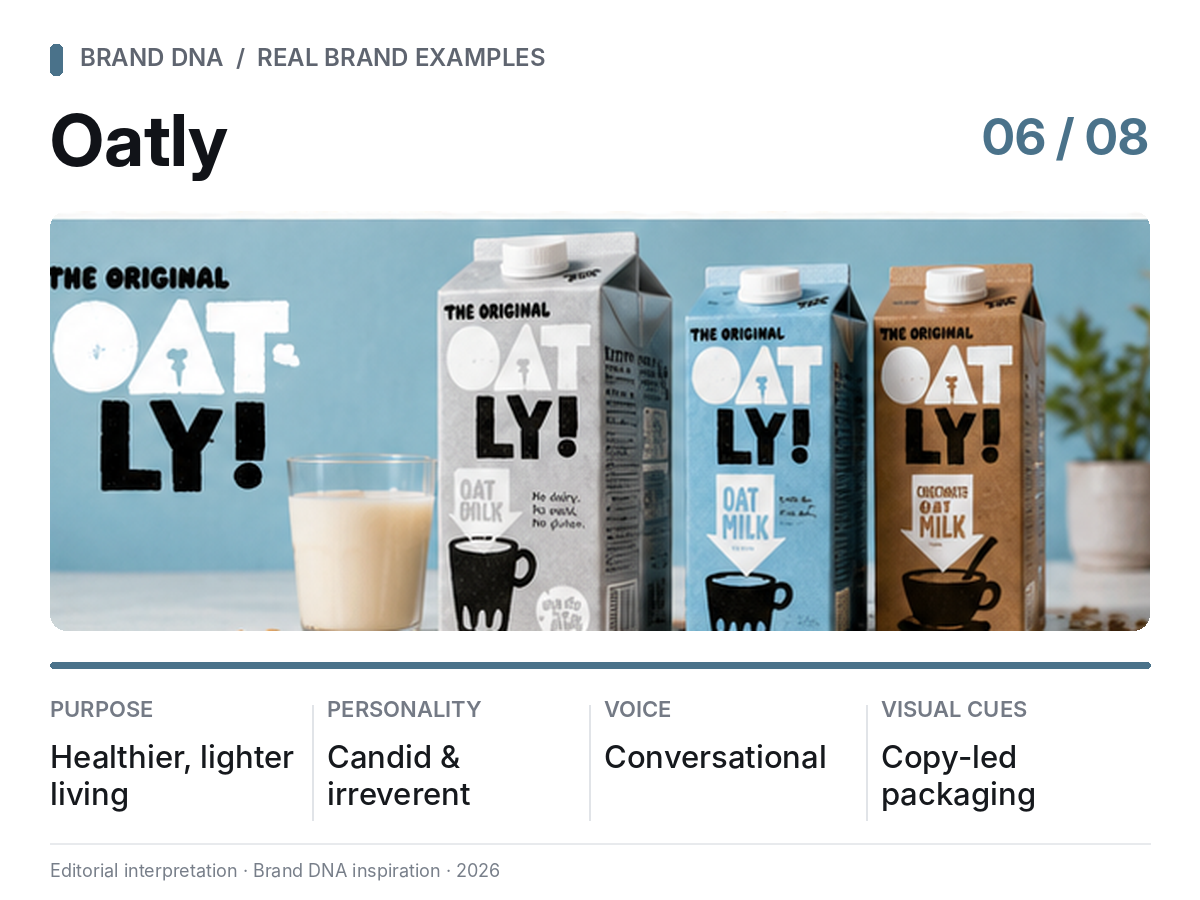
Brand DNA snapshot: Purpose: make it easier to live healthier lives without recklessly taxing the planet’s resources. Personality and voice: candid, irreverent and conversational. Visual cue: copy-forward packaging.
What makes it unique: Oatly’s public “Oatly Who” page explains its mission in plainspoken language, then carries that same attitude into the way it talks about food and the planet. The voice feels like part of the product experience because it appears on cartons, web pages and campaigns—not only in a brand statement. See how Oatly describes its mission.
What you can learn: Your voice can be a recognizable brand asset. Use it consistently in the places customers actually encounter you, and make sure it still sounds credible for your business.
7. Notion: Flexible tools, one clear promise
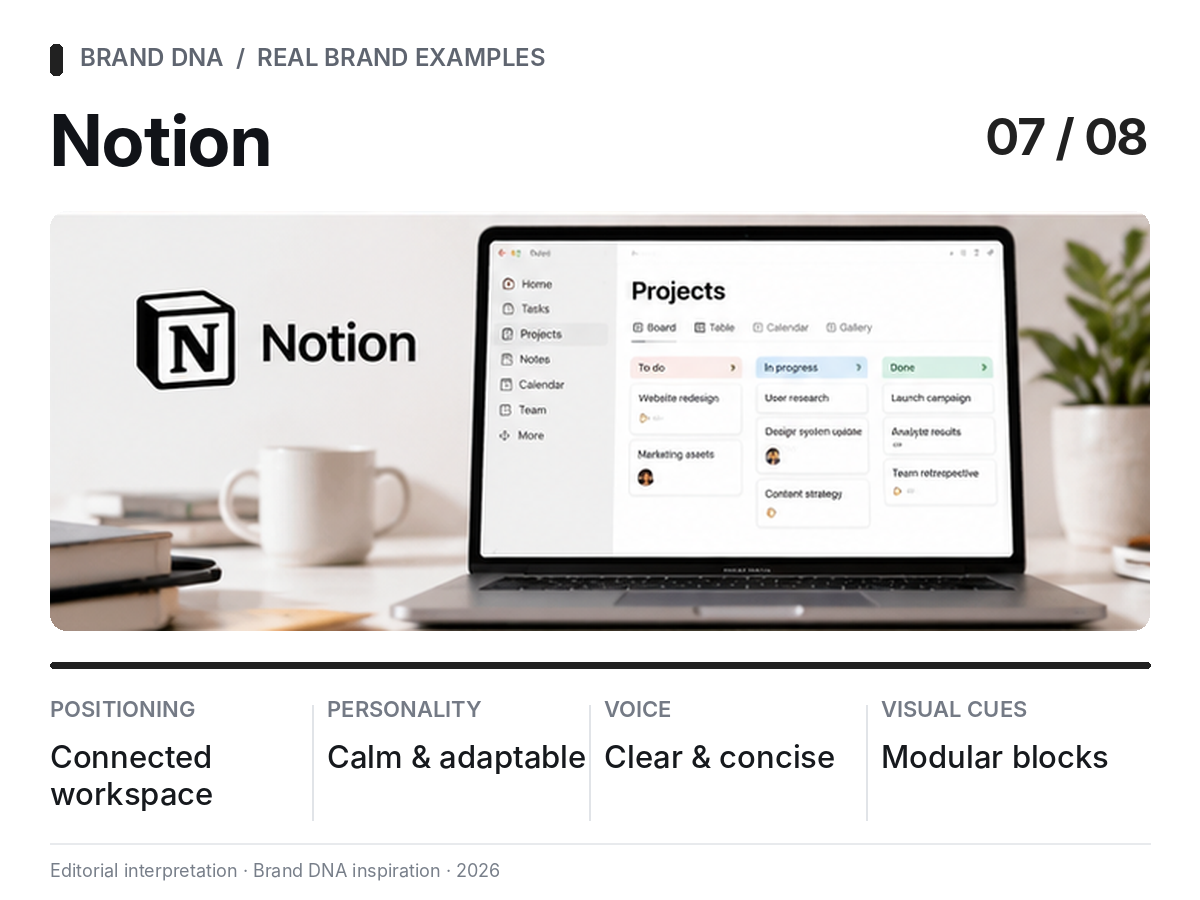
Brand DNA snapshot: Positioning: a connected workspace for documents, wikis, projects and databases. Personality and voice: calm, clear and adaptable. Visual cue: a restrained interface built from flexible blocks.
What makes it unique: Notion presents a connected workspace for documents, projects, knowledge and more. The distinctive move is to keep one broad promise while letting teams configure workflows from flexible building blocks. See Notion’s product overview.
What you can learn: Make your promise easy to grasp, even if the product can do many things. Clarity helps people see where to start; flexibility gives them reasons to stay.
8. Airbnb: Belonging as the idea behind the stay
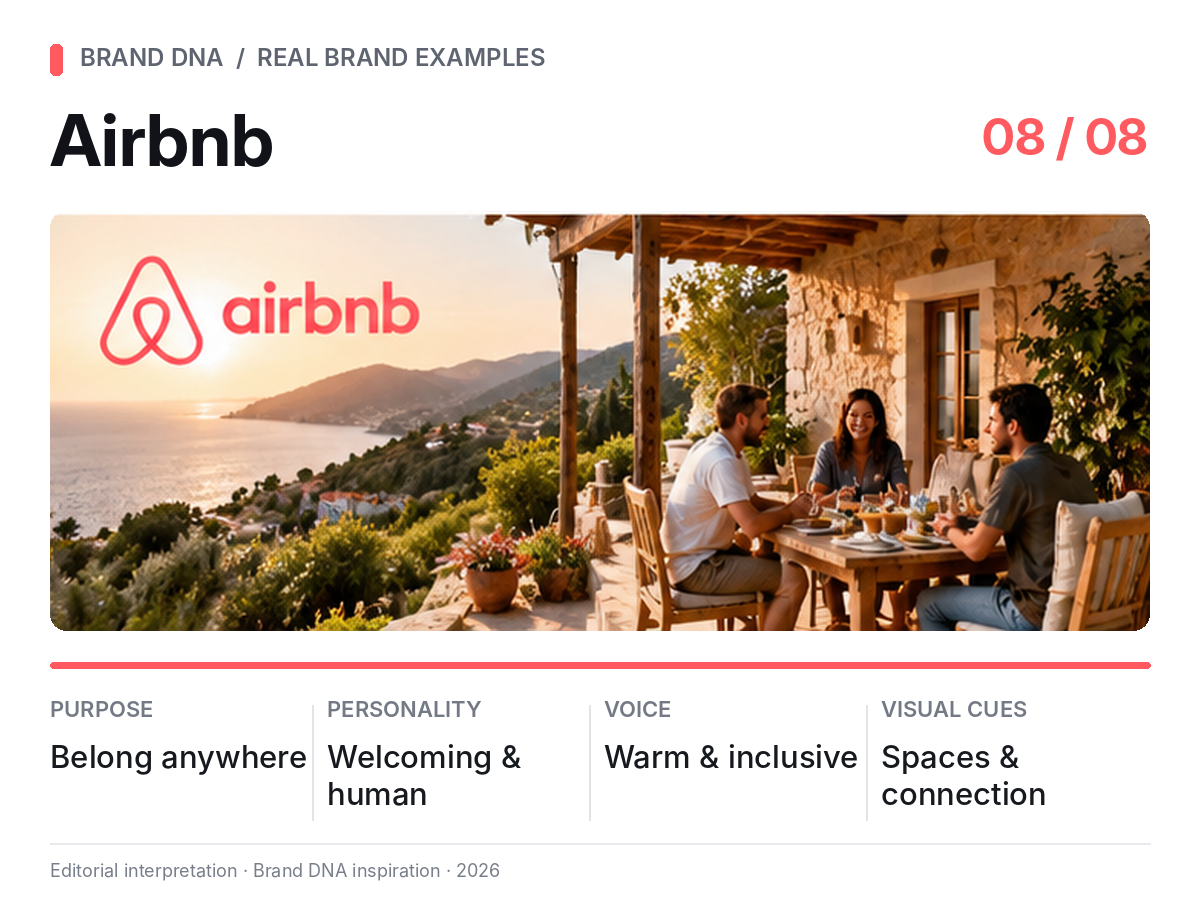
Brand DNA snapshot: Purpose: help create a world where anyone can belong anywhere. Personality: welcoming and human. Visual cue: the Bélo mark, read here as a visual expression of belonging.
What makes it unique: Airbnb frames travel around belonging and connection, not only accommodation. That purpose gives a stay a human meaning beyond the place itself. Read Airbnb’s mission.
What you can learn: A brand can stand for the feeling around a product, not just the product category. Find the human outcome customers care about and make it part of the experience.
What Do These Brand DNA Examples Have in Common?
These brands do not share one personality, color palette or slogan. They share a stronger pattern: their public signals point in the same direction.
- Purpose narrows choices. Nike’s action, IKEA’s everyday usefulness and Airbnb’s belonging each give the brand a different filter for decisions.
- Personality shows up in behavior. Duolingo makes learning playful in the product; LEGO invites people to create; Oatly carries its voice onto packaging.
- Visual cues make ideas recognizable. A symbol, interface, character or product system can help people recognize a brand before they read its mission.
- Consistency is not sameness. Strong brands repeat their own point of view across experiences. They do not need to borrow another company’s colors, tone or tagline.
Use these examples to study the logic behind a brand—not to copy its logo, palette or wording. A useful Brand DNA profile connects what a company stands for with what customers repeatedly see and hear.
Create Your Own Brand DNA From Your Logo
Start with an uploaded logo in LogoAI’s Brand DNA Generator to shape an editable profile of your brand. It can suggest your audience, positioning, personality, voice, colors, typography, mission, vision and slogan. Add a short business description when the logo alone does not provide enough context, then review and adjust the suggestions before saving. If you don’t have a logo yet, LogoAI’s AI logo maker can create concepts from your business name and a short description; you can then use a selected logo as the starting point for your profile.
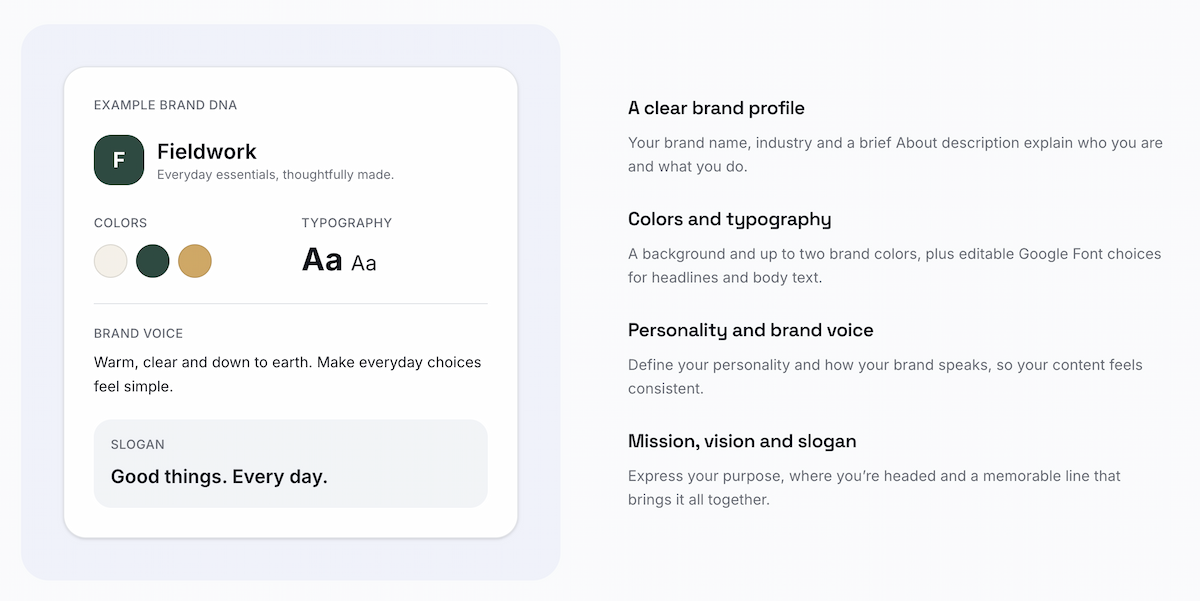
Treat the profile as a working draft, not a final verdict about your business. The useful part is making the choices visible: what you want to stand for, how you want to sound and which visual cues should stay consistent.
Nike’s DNA is built to move people to act; IKEA’s is built to make design work for everyday life. Your brand does not need either one. It needs a set of choices that feels true to your business—and clear to the people you want to reach.
Ready to create your own logo?
Turn your brand name into professional logo concepts in seconds with LogoAI.
Generate my logo